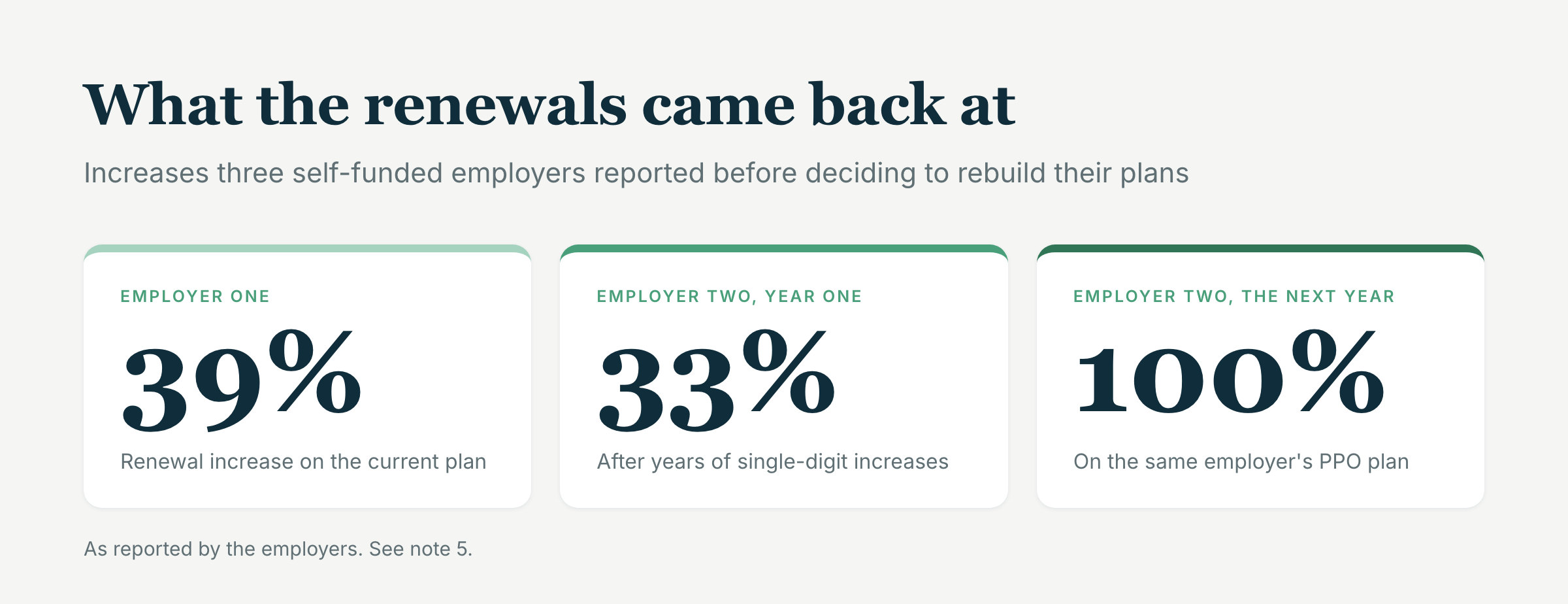
Self-funded employers are opening renewal letters that would have been unthinkable a few years ago. One mid-sized employer’s plan came back at a 39 percent increase. Another absorbed years of single digit increases, then a 33 percent year, and then a 100 percent increase on its PPO plan. At that scale, an employer starts asking what the plan is even paying for (and to whom).
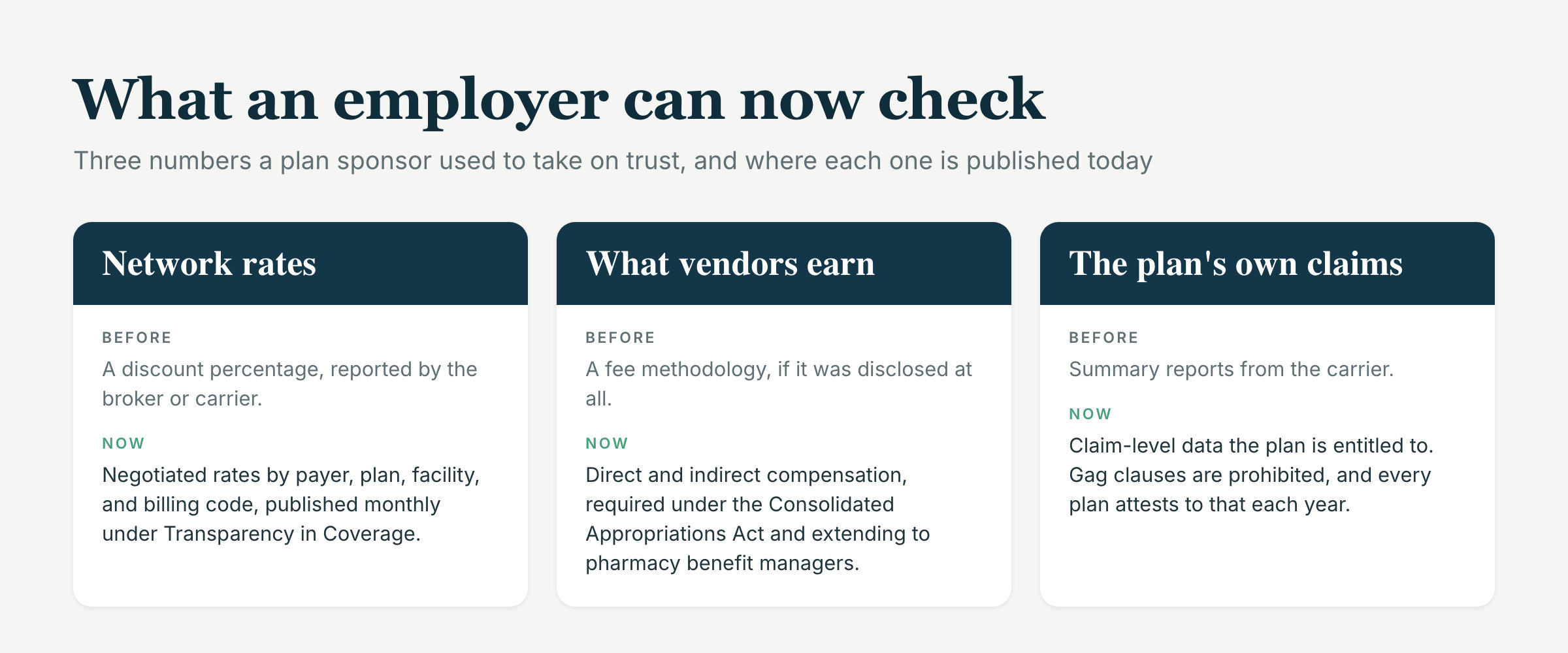
For most of the last two decades that question had no answer an employer could check. If a broker said the network discount was good, it was up to the employer to decide whether to believe it, and the conversation ended there. The negotiated rates behind the discount are now published, and so is what the plan’s vendors are paid. Verification has replaced belief as the starting point.
Where the cost is going
Hospitals have two payers of consequence, government and employers, and the government side is shrinking. One physician who runs a direct care practice put the arithmetic plainly. Federal reconciliation has cut what Medicaid pays. He cited the Congressional Budget Office estimate of roughly $321 billion in reduced Medicaid reimbursement and expects the realized figure to run higher. Enhanced exchange subsidies are ending, and on his numbers roughly eight million more people become uninsured, arriving at hospitals through emergency departments without the benefit of preventive care.
Hospitals absorbing that population are looking for ways to recover the difference, and commercial contracts are one of the few places left to do so. Employers will see the result in renewal cycles they are not party to negotiating.
The discount, checked against the files
Some of this is observable before it reaches a renewal letter. Under the Transparency in Coverage rule, payers publish machine readable files carrying their negotiated rates by payer, plan, provider, and billing code, refreshed monthly. These are public datasets, which means the rate a health system charges a competitor’s plan is no longer private information. Changes to commercial rates appear in those files as they are refreshed, so an employer watching the systems in its own footprint can see movement before a renewal letter arrives.
What that looks like in practice is a single chart. Take one market, one large commercial payer, and one common procedure. In Phoenix, UnitedHealthcare’s published files carry what it has agreed to pay each of the large hospital systems for a hip or knee replacement without major complications, and those rates can be lined up as a multiple of what Medicare pays the same hospital for the same admission.
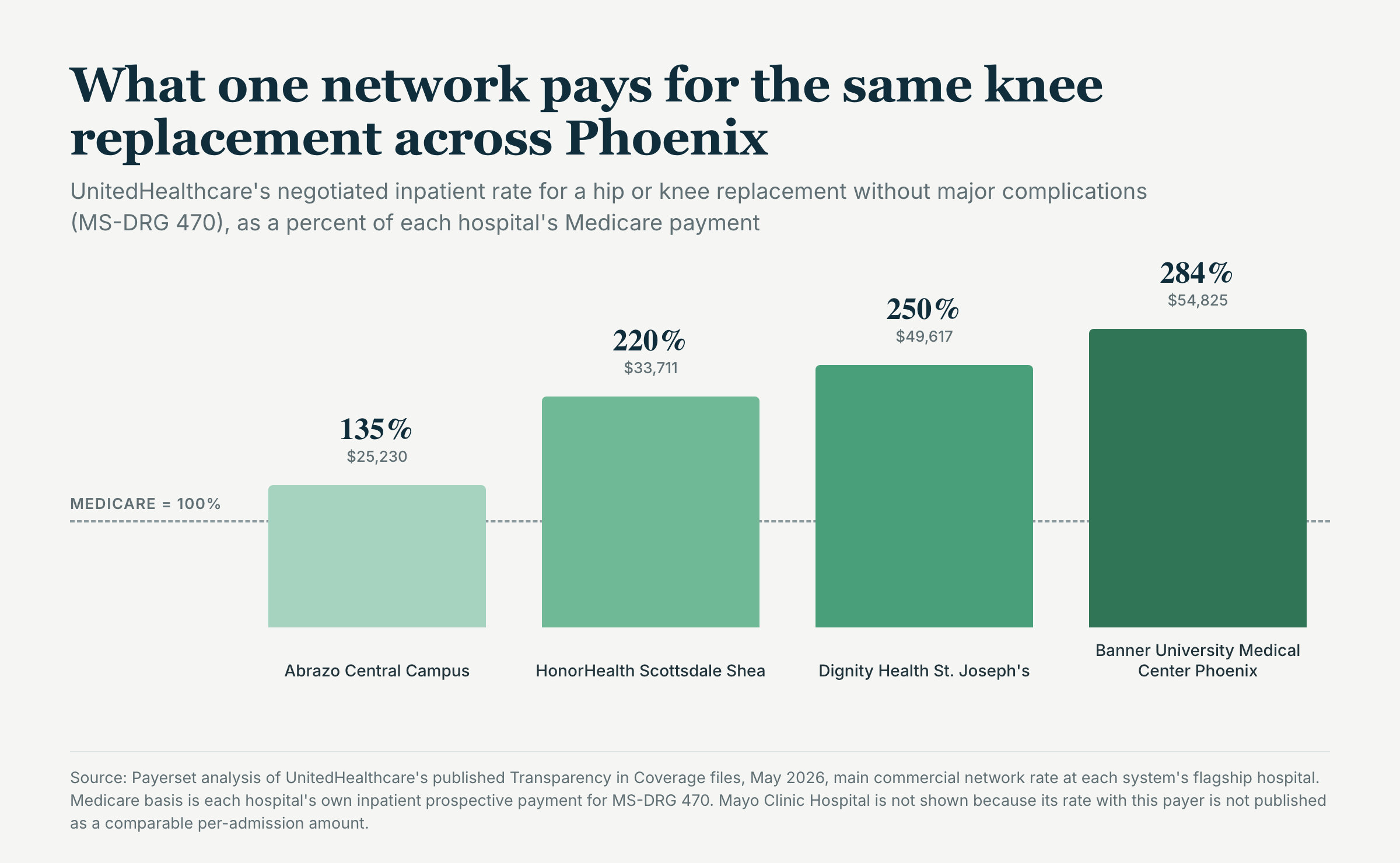
The spread between the lowest and highest system in a single market is the number an employer never sees on a renewal letter. In Phoenix, the same admission under the same network pays about $25,200 at Abrazo Central and about $54,800 at Banner University Medical Center, 135 percent of Medicare at one end and 284 percent at the other. The network discount is presented as one figure. The rates behind it vary by facility, and an employer whose members concentrate at the most expensive system is paying for that concentration whether or not anyone has shown them the chart.
One advisor has a question for the industry that grew up without that chart.
When did the industry become faith-based?A benefits advisor
Transparency in Coverage files and hospital price transparency files changed the terms of that conversation. The underlying rates are published, so an employer can compare what a network pays a given facility against what a direct contract offer puts on the table before signing anything. The employers who made a move describe a year of diligence, line by line contract review, and questions put to every vendor involved in the plan.
What the plan’s vendors earn
The same instinct to verify is showing up in how employers handle what their brokers and vendors are paid. The compensation disclosures that make this possible exist because the Consolidated Appropriations Act of 2021 required brokers and consultants to disclose direct and indirect compensation to plan fiduciaries. [1] One advisor estimates that a large majority of the disclosures his firm reviews are not clear enough to be useful, because they describe how a fee is calculated without ever stating the dollar amount. Another puts the standard plainly.
A disclosure of a methodology is not a disclosure. A disclosure of an amount is.A benefits advisor, on broker compensation
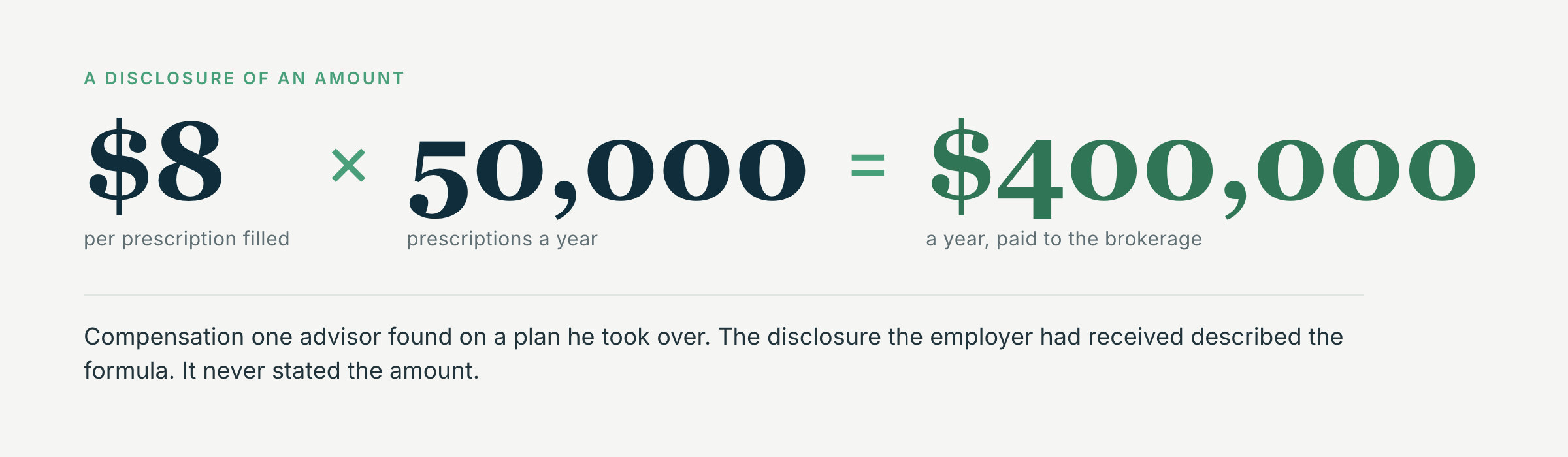
He described taking over a plan and finding an arrangement that paid the brokerage firm $8 for every prescription filled. On a plan filling 50,000 prescriptions a year, that came to $400,000 a year in compensation the employer had never been told about.
Federal rules moved further in the same direction this year. Fee disclosure obligations under ERISA now extend to entities providing pharmacy benefit management services, and rebates have to be passed through to the plan. [2] A proposed Department of Labor rule would require those entities to disclose direct and indirect compensation to plan fiduciaries before a contract is signed, with audit rights attached, though it has not been finalized. [3] A wave of fiduciary lawsuits against large plan sponsors over pharmacy spending has made the stakes concrete. For a plan sponsor, the practical effect is that asking what a vendor earns is a fiduciary obligation.
What verification makes possible
Direct contracting means an employer, or a plan acting on its behalf, negotiates rates straight with a hospital or physician group instead of accepting the rates a carrier has already agreed to inside its network. Until recently that took the staff and administrative capacity of a very large employer. Advisors are now assembling networks of directly contracted clinicians for mid-sized clients, and plans built on this model are signing hospital agreements market by market, including in smaller markets that have never had a direct contracting option.
Why would a hospital agree to a lower rate? Because employers often assume patient volume is the only thing they have to trade. One direct care organization’s first hospital system partner agreed to cut its negotiated commercial rates by 20 percent, knowing the arrangement would send that hospital fewer referrals overall.
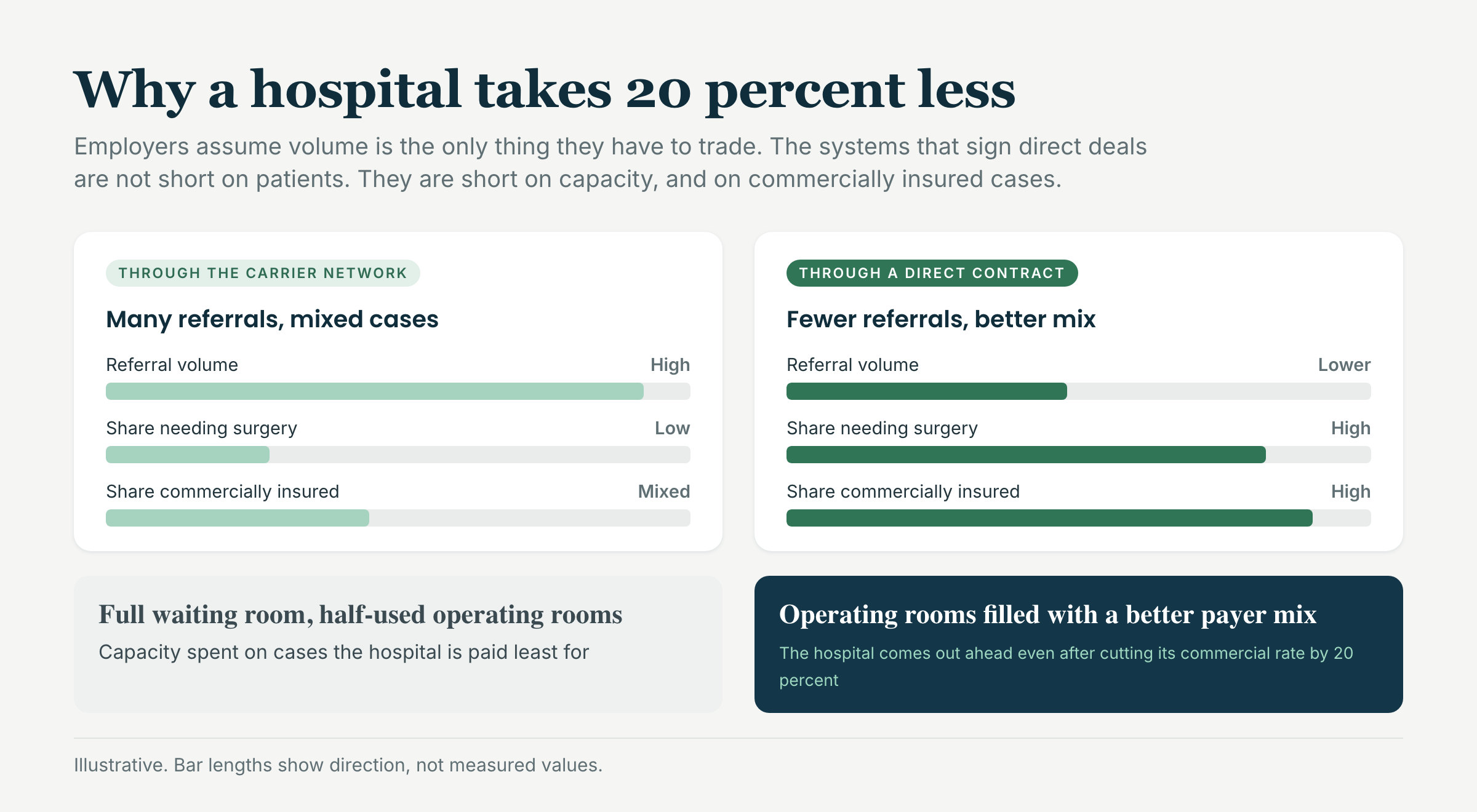
The trade works because these systems are not short on patient demand. They are constrained on capacity, and on the share of their patients who carry commercial insurance. If a direct arrangement sends a smaller number of referrals but a higher share of them arrive needing surgery and covered commercially, the hospital fills its operating rooms with a more favorable payer mix and can come out ahead even after the rate reduction.
One district’s numbers
What this looks like from inside a plan is easiest to see in one employer’s numbers. Under the same 2021 law, plan sponsors can no longer be bound by gag clauses that block access to their own claims and cost data, and every plan has to attest each year that it is not. [4] That is the legal footing for what one school district found.
The superintendent of a Wisconsin high school district described what changed once he had his own claims data. Moving to a self-funded structure dropped his plan’s maximum liability by $333,000 before a single claim was filed. He returned about half of that to employees through plan design, and they noticed the benefit in their paychecks and at the point of care. The other half went back into the district.
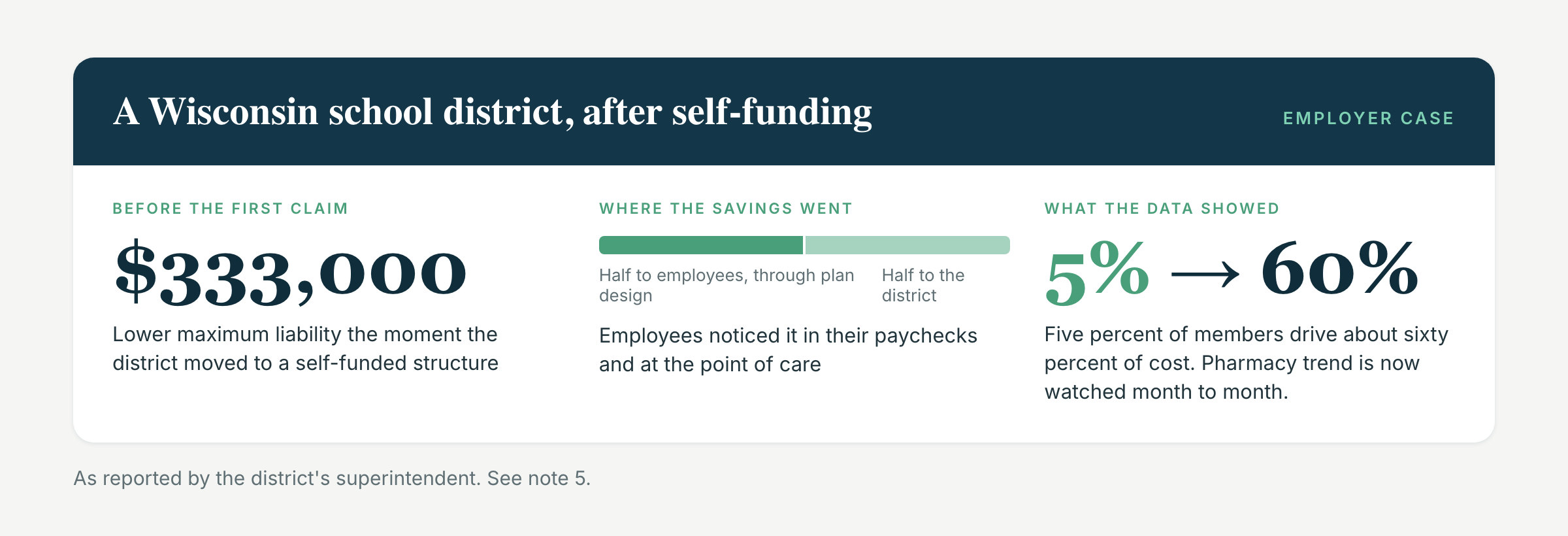
What changed underneath was visibility. He found that five percent of his members drive about 60 percent of his cost, a distribution nobody had ever shown him. He now watches pharmacy trend month to month. None of that was available to him under a fully insured arrangement, and both findings let him tailor the plan to his population and his bottom line. He took ownership of his own claims data first, checked what it showed against what he had been told, and acted on the difference.
Questions to bring to your next renewal
The employers who rebuilt did not start with a vendor change. They started with questions. These are the ones that come up most.
- Do we have our claims data, and can we get it in a form we can analyze? Your plan’s gag clause attestation says you are entitled to it. Ask your carrier or third party administrator for the file, not a dashboard.
- What does every party in our plan earn, in dollars? Ask brokers, consultants, and pharmacy benefit managers for the amount, not the formula. A per-script or per-member fee should be multiplied out.
- What does our network actually pay the five facilities where our members go most? The negotiated rates are public. Ask for them as a multiple of Medicare so they can be compared across systems and against any direct offer.
- Which of our members drive most of our spend, and what are they being treated for? A small share of members usually accounts for most of the cost, and plan design should be built around them.
- Is a direct arrangement available in our market, and at what rate? Direct contracting has moved down market. If a hospital or physician group will contract directly, the transparency files tell you whether the offer is a discount to what the network already pays.
Notes
- U.S. Department of Labor, Employee Benefits Security Administration. Field Assistance Bulletin 2021-03: Group health plan service provider disclosures under ERISA section 408(b)(2)(B). December 30, 2021.
- Risk Strategies. PBM Reform: Recent Developments Under the CAA 2026 and DOL Proposed Rule. 2026.
- U.S. Department of Labor, Employee Benefits Security Administration. Improving Transparency into Pharmacy Benefit Manager Fee Disclosure, proposed rule. 91 Fed. Reg. 4045. January 30, 2026.
- Centers for Medicare & Medicaid Services. Gag Clause Prohibition Compliance Attestation, required annually under section 201 of the Consolidated Appropriations Act, 2021.
- Quotations and figures attributed to employers, advisors, and physicians are as reported by the speakers at a self-insured employer and advisor summit in St. Louis, September 2, 2026, and checked against the recordings. Speakers are identified by role. The figures are the speakers’ own numbers, not independent audits.