On October 6, 2026, the Departments of Health and Human Services, Labor, and the Treasury published final amendments to the Transparency in Coverage rules.[1] The rule takes effect December 7, 2026, and finalizes most of what was proposed last December, with a few changes that matter for anyone working with payer files.
Since payers began posting in 2022, the files have released an enormous amount of once-hidden pricing data, along with massive file sizes, duplicated records, and rates nobody is ever paid. This rule is the clearest sign yet that price transparency policy is moving from getting the data out to making it usable, and many of the changes trace directly to feedback from the people who work with these files every day.
The headlines:
- One in-network rate file per provider network, with a network name and a new network identifier
- Rates removed for providers unlikely to be paid for a service given their specialty, backed by new Taxonomy and Utilization Files
- More out-of-network data, organized by market type
- Quarterly updates for in-network and out-of-network files
- An accuracy attestation and a named senior official in the rate, allowed amount, Taxonomy, and Utilization files
- The proposed Change-log File and plan enrollment totals did not make the final rule
The timeline from requirement to reality
The proposal gave plans a single 12-month runway. The final rule phases requirements in from early 2027 through mid-2028.[1][2]
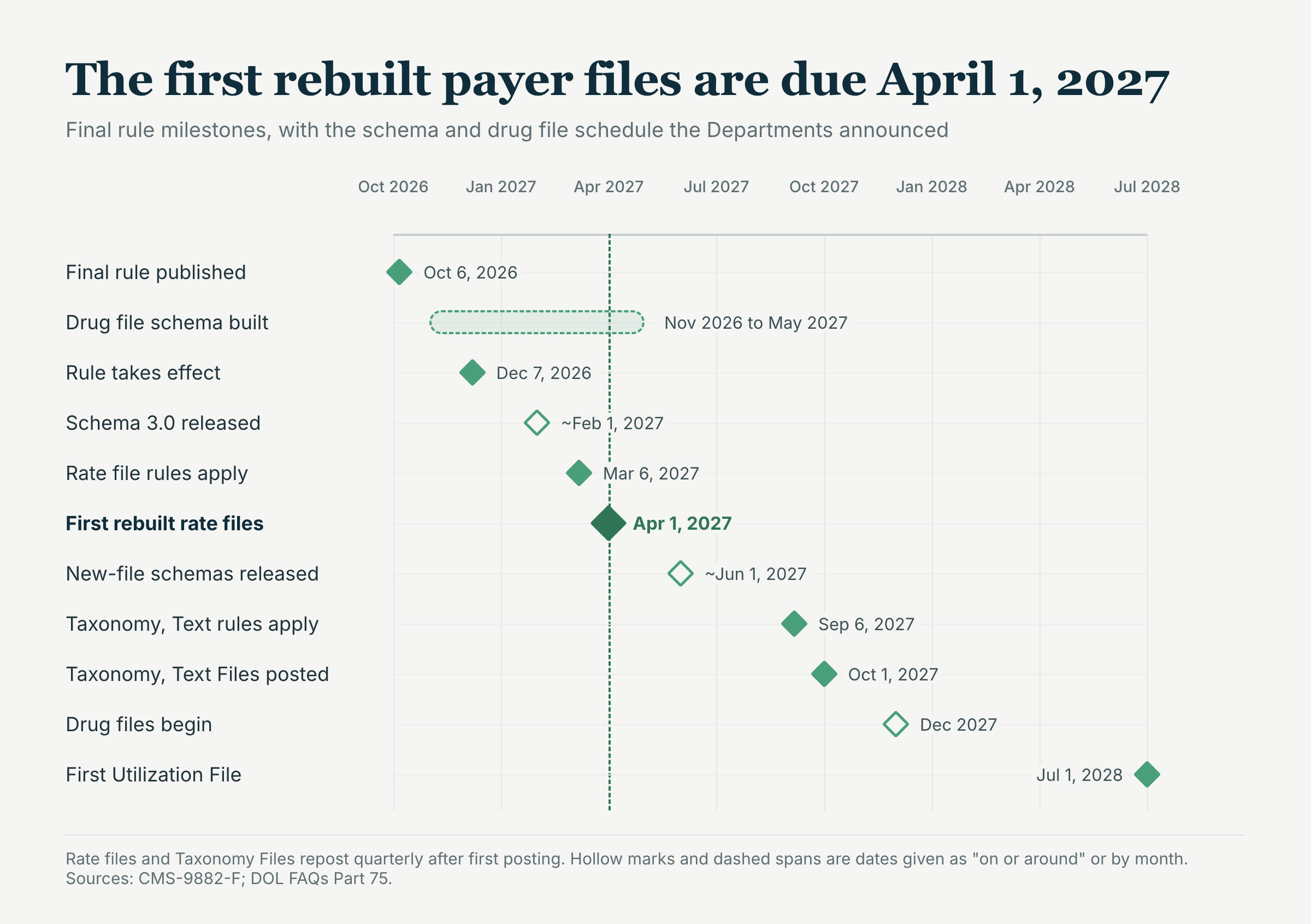
The network files arrive first and the Utilization File last, so file users will work with the new structure for more than a year before the payment flag arrives.
One file per network
Plans and issuers will publish one In-network Rate File per provider network, replacing the 2020 requirement of one file per plan.[2] The old structure produced massive duplication. A regional Blue Cross Blue Shield plan offering 50 commercial plan variations on a single network, for example, would post 50 files with the same provider list and the same rates, different only in the plan identifier at the top. Organizing by network removes that repetition and lines payer files up with how hospitals already report, by payer and network, so the two datasets compare more cleanly.
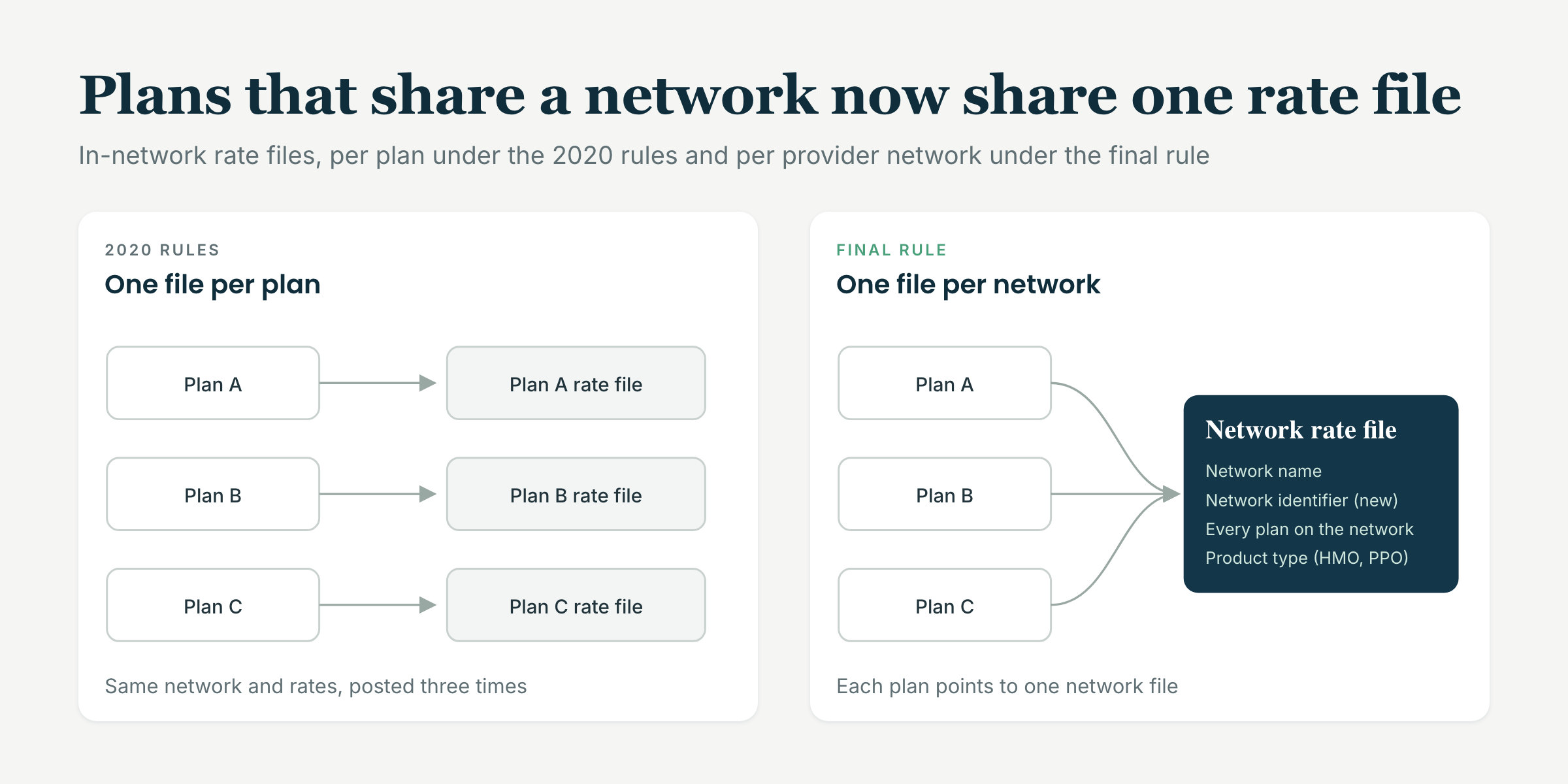
Each network file must include:
- The common provider network name
- A provider network identifier, new in the final rule
- Every plan or coverage option that uses the network
- Product type, such as HMO or PPO, for each plan
- Rates as dollar amounts, with a percentage allowed for percentage-of-billed-charges contracts when a dollar amount can’t be set in advance[1]
How consistently payers define their networks will decide how much easier the files are to navigate.
Clearing out zombie rates
Rate files have listed a negotiated rate for every provider a plan contracts with, whether or not that provider ever bills for the service. These zombie or ghost rates add noise to any benchmark, such as a rate for a pediatric cardiologist performing knee replacements or for providers who haven’t billed the plan in years. The Departments trace much of it to contracts negotiated at the group level for every provider regardless of specialty, which is how a file ends up pricing a podiatrist for heart surgery.[2] Three provisions work together on the problem, one new rule and two new files:
- Exclusions (a rule, not a file). Plans must remove from their in-network rate files any provider-rate combination a provider is unlikely to be paid for given their specialty, using the same internal rules they already apply when processing claims.
- Taxonomy File (the rulebook behind the exclusions). A new file, posted with each in-network rate file, that discloses the specialty mapping or other rules the plan used to make those exclusions. In plain terms, it shows which provider specialties the plan treats as valid for each billing code.
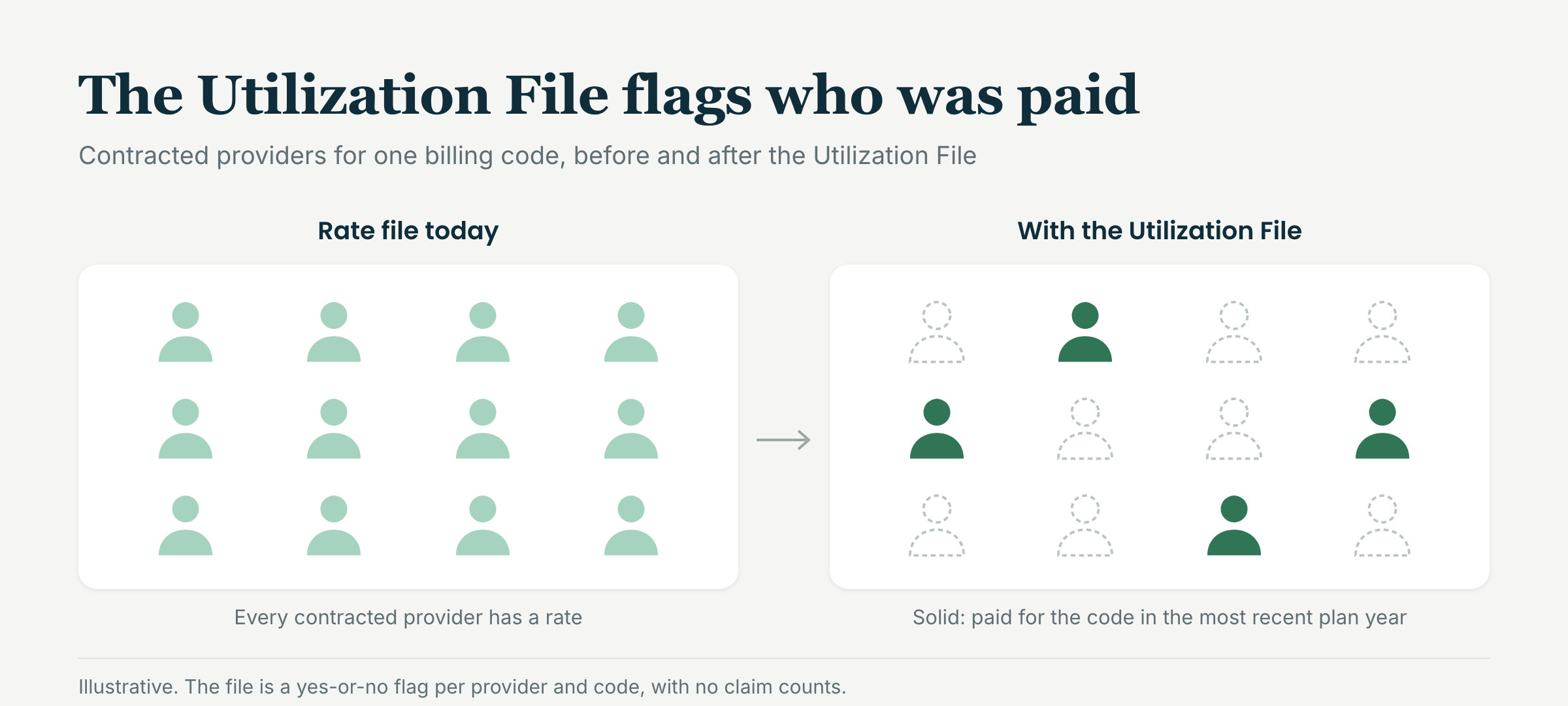
- Utilization File (the proof of payment). A list of every provider paid for at least one claim for a service during the most recent plan year ending six months before posting. The first one is due July 1, 2028.[4]
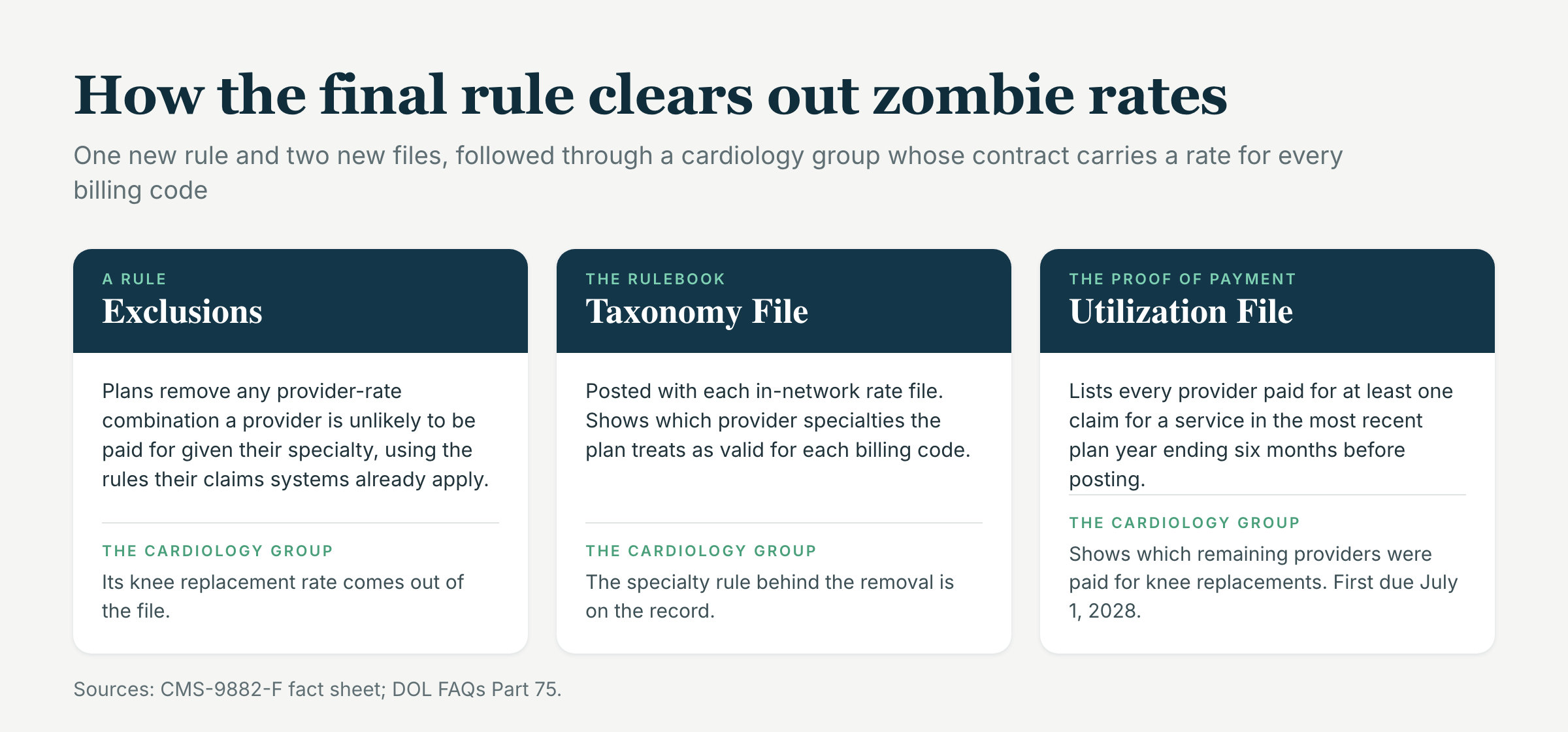
Here is how the three fit together. Say a cardiology group’s contract carries a rate for every billing code. Under the exclusion rule, the plan drops that group’s knee replacement rate, because its claims system would never pay a cardiologist for one. The Taxonomy File shows the specialty rule behind that removal. The Utilization File later shows which of the remaining providers were paid for knee replacements. When a rate is missing, readers can now tell whether no contract exists, the plan’s specialty rules excluded it, or it was dropped for another reason.
The Utilization File is a yes-or-no flag. It shows whether a provider was paid for a code and leaves out claim counts, which the Departments considered and did not adopt.[1] It works as a first-pass filter that separates paid rates from rates that exist only on paper, while volume and market share still depend on claims data.
More out-of-network data
- Claims threshold drops from 20 to 11
- Reporting period extends from 90 days to six months
- Lookback period extends from 180 days to nine months
- Data is reported by market type: individual, small group, large group, and self-insured
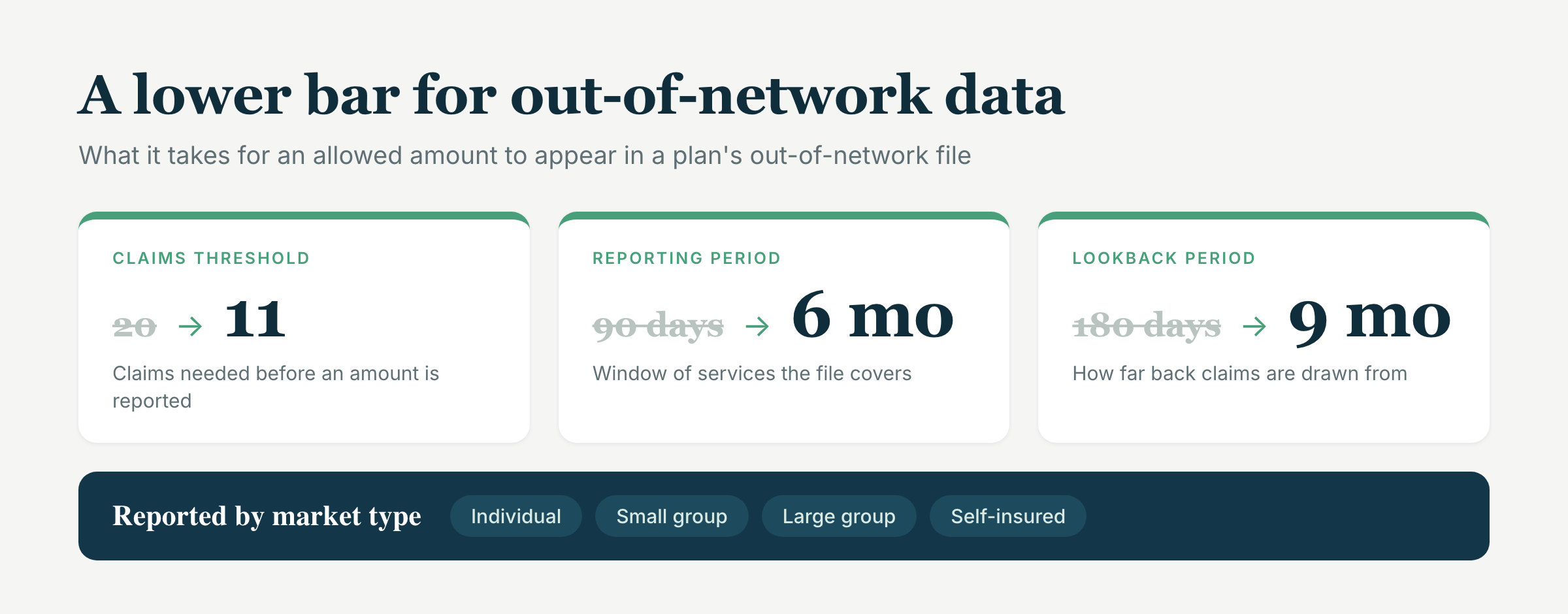
Many plans post out-of-network files with little or no data today, and the Departments expect these changes to increase it substantially.[2] Eleven claims is still a floor, so rarely billed services may continue to fall short.
What would that mean in practice? With fuller files, users can see what plans allow for care from providers outside their networks, market by market, and how far that sits from what those providers bill.
- Employers weighing reference-based pricing. A market-level picture of what plans allow for out-of-network care gives a real-world reference point when setting what to pay providers outside a network, instead of starting from billed charges.
- Patients and advocates facing a balance bill. The files pair billed charges with allowed amounts, so the gap between the two shows roughly what a patient could be billed in situations the No Surprises Act does not cover.
- Network adequacy reviews. Which services and specialties show up in a market’s out-of-network files can point to where members are leaving the network for care, a sign the network may be thin there.
Accountability and access
Since 2022, anyone using the Transparency in Coverage files (the machine-readable files posted by health plans and insurance carriers) has worked with data no one formally vouched for, posted in formats that varied by payer, on pages that could take significant effort to find. These provisions change that. For a hospital benchmarking rates, an employer checking its contracts, or an advisor answering to a client, they mean less time hunting for and cleaning files, more confidence in what the files say, and a clear line of responsibility when something is wrong.
- Attestation. Every in-network, out-of-network, Taxonomy, and Utilization file must attest that the data is true, accurate, and complete.[2]
- Prioritized enforcement. The Departments say they will prioritize compliance and enforcement and will work to make enforcement actions public.[1]
- Named official. Each file, including the drug file, must carry the name of the CEO, president, or senior official responsible for it.
- JSON for the data. Every file that holds data, meaning in-network rates, out-of-network allowed amounts, drug prices, taxonomy, and utilization, must be published in JSON.[4]
- Text file as a directory. A plain-text file in the root folder of the website that hosts the files lists the page that hosts the files, direct links to them, and contact information, including a monitored email. It holds no rates and must be updated within seven days of any change.[2][4]
- Footer link. That website’s homepage must carry a footer link titled “Price Transparency” or “Transparency in Coverage” that goes straight to the files.
- Quarterly updates. In-network and out-of-network files move from monthly to quarterly, while drug files stay monthly. The Departments say networks and rates don’t change much month to month, so little meaningful data is lost.[2]
What changed between the proposal and the final rule
Most proposed provisions were finalized as written. These are the ones that changed.
| Provision | Proposed (December 2025) | Final (October 2026) |
|---|---|---|
| Network identifier | Network name only | Network name plus a network identifier |
| Applicability | Most changes 12 months after the final rule | Phased from five months to mid-2028 |
| Utilization File | Providers paid for at least one claim, rolling 12 months | Same yes-or-no flag, tied to the most recent plan year; no claim counts |
| Change-log File | Filed with each in-network file, listing what changed since the last one | Not finalized |
| Enrollment totals | Enrollment for each plan using a network | Not finalized |
Without the Change-log File, spotting quarter-over-quarter rate changes means comparing full files.
What it means for you
- Hospitals and managed care teams. Benchmarking gets cleaner. Network files should map more directly to contracts, specialty exclusions cut noise, and the Utilization File will narrow comparisons to providers paid for the service in question.
- Employers and benefits advisors. Confirm who posts your plan’s files, who signs the attestation, and what your administrator contract says if the files are wrong. Product type and market-level out-of-network data also make plan-to-plan comparisons easier.
- Researchers and data teams. Expect updated schemas, a JSON-only format, and a text file that makes automated file discovery reliable. Without a Change-log File, plan on building your own quarter-over-quarter comparisons.
What to watch when the first files post
- Network definitions. Whether payers draw network lines consistently enough that the right rates are easy to find.
- Exclusions. Whether specialty logic strips rates some providers do bill, which the Taxonomy File should reveal.
- Data quality. Whether attestations and named executives produce cleaner, more current files.
Next up: the prescription drug file
The drug file is the third file the 2020 rules required, alongside in-network rates and out-of-network allowed amounts, and the only one that never got a firm compliance date. That changes in December 2027.[3][4]
What the rules require it to show
- Each covered drug by National Drug Code, with the proprietary and nonproprietary names the FDA assigns it[5]
- The negotiated rate for each drug, tied to each in-network pharmacy or other dispenser[5]
- A historical net price, meaning the average amount the plan paid after reasonably allocated rebates, discounts, chargebacks, fees, and other price concessions, for a 90-day period that begins 180 days before the file is published[5]
- Drugs paid under fee-for-service arrangements, which the regulation routes to the drug file and out of the in-network rate file[5]
How we got here, and what comes next
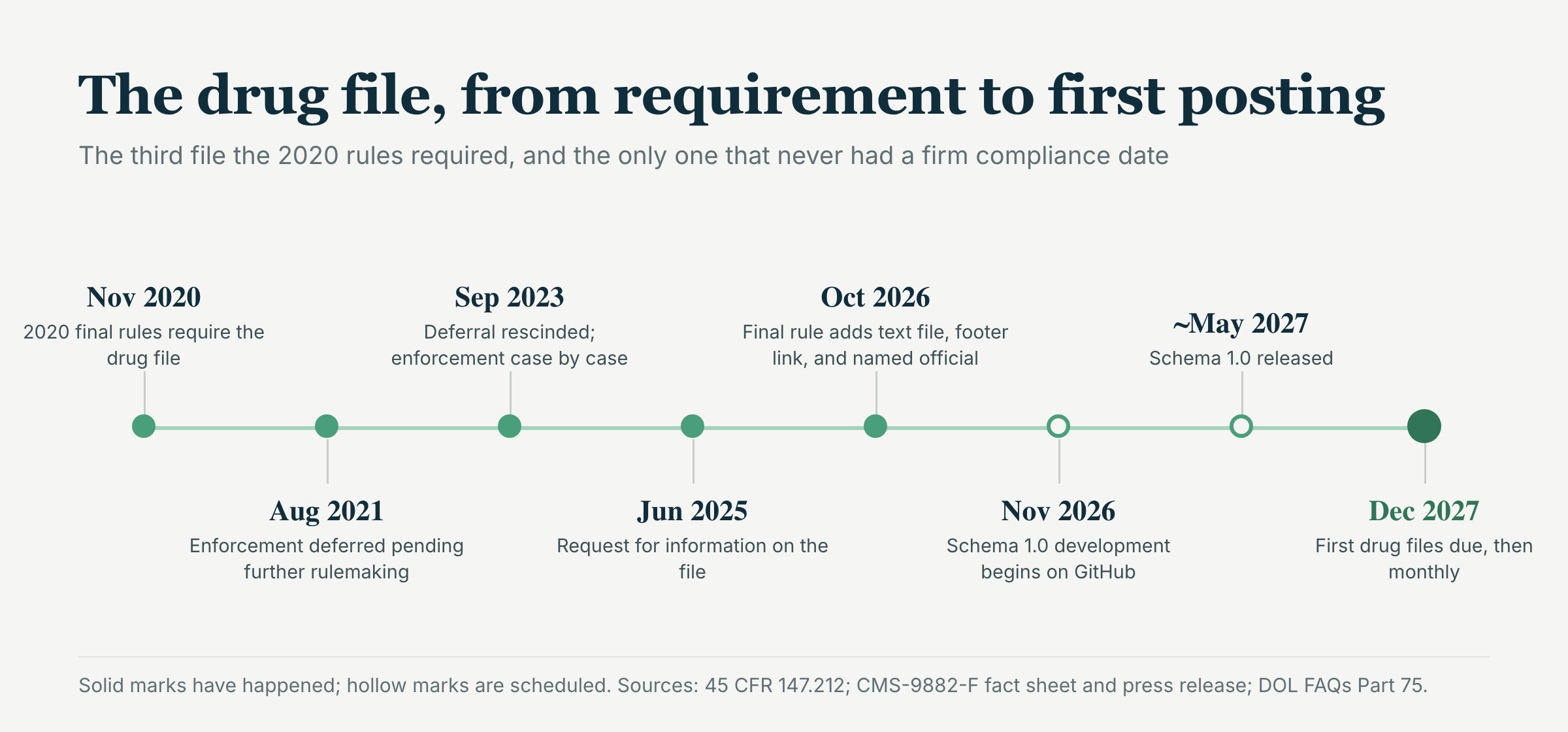
Sources for each milestone: the 2020 requirement[5]; the 2021 deferral[4]; the 2023 rescission[2][4]; the 2025 request for information[2]; the 2026 final rule[2][4]; and the schema and first-posting schedule.[3][4]
What to expect
- The content rules are already written. The Departments say the schema will be built on the 2020 and 2026 rules, which points to the November-to-May work focusing on how drugs, dispensers, and prices get encoded.[4]
- Net prices are the prize. Setting negotiated rates beside historical net prices could show, across every plan, how much rebates and other concessions change what a plan pays for a drug.
- Thin data is still possible. Historical net prices must be left out for any drug and provider with fewer than 20 claims, the same kind of floor that has limited the out-of-network files.[5]
You also do not have to wait until December 2027 to see what this data looks like. Payerset’s prescription drug tool already lets anyone look up what health plans have negotiated with pharmacies for a given drug, drawn from the payer drug files posted today.
Drug pricing runs through manufacturers, wholesalers, pharmacy benefit managers, and plans, with money moving in several directions, so the drug file could expose variation the medical files never captured. The Price Transparency Project will track the schema work from November and report on the first files as they post.
Frequently asked questions
When does this take effect? The rule is effective December 7, 2026. The new in-network and out-of-network file requirements apply March 6, 2027, and the first rebuilt files must be posted April 1, 2027, then on the first day of each quarter. The Taxonomy File and Text File requirements apply September 6, 2027, with first posting October 1, 2027. The first Utilization File is due July 1, 2028.[1][4]
Will file sizes shrink? The Departments expect a significant drop in duplicate rates, file sizes, and the number of files.[4] How much depends on how payers define their networks, which the first files will show.
Will plan-level detail still be available? Yes. Each network file lists every plan or coverage option that uses the network, along with its product type, so a specific employer plan can still be traced to its rates.
How do the Taxonomy File and Utilization File work together? The Taxonomy File shows which provider-service combinations the plan considers appropriate. The Utilization File shows which of those combinations were paid. Together they separate rates that could be used from rates that are driving claims.
What happened to the Change-log File? It was not finalized. Tracking which rates moved between quarters now falls to the people using the files.
Do self-funded employers have to post their own files? The legal obligation sits with the self-funded employer, as the sponsor of its health plan, not with the third-party administrator. A self-funded employer can have its administrator post the files, and the rule lets an administrator post a single network file covering many self-funded employers’ plans.[1] If the administrator falls short, the self-funded employer remains responsible, which makes the administrator contract the place to settle it.[1]
What happens to the technical schema? New versions are coming, developed with industry on GitHub, the same way Schema 2.0 was. Schema version 3.0 for the in-network and allowed amount files will be released by the Departments on or around February 1, 2027, and schema version 1.0 for the new Utilization, Taxonomy, and Text files on or around June 1, 2027.[4]
Notes
- Transparency in Coverage final rules (CMS-9882-F), 91 FR 63748. Federal Register, October 6, 2026. federalregister.gov
- CMS. Transparency in Coverage Final Rules (CMS 9882-F) fact sheet. October 5, 2026. cms.gov
- CMS. New Regulations Make It Easier to Find, Compare, and Report Healthcare Pricing and Coverage Information. October 5, 2026. cms.gov
- U.S. Department of Labor. FAQs About Affordable Care Act Implementation Part 75. October 7, 2026. dol.gov
- 45 CFR 147.212, Transparency in coverage, requirements for public disclosure. Electronic Code of Federal Regulations. ecfr.gov
- Texas Insurance Code, Chapter 1662, Health Care Cost Transparency, Section 1662.103. tcss.legis.texas.gov